Friday, August 14, 2020

MARCO!... POLO!

Marco Polo according to Geico
It's kinda stupid, right? But who isn't for a little stupid fun in the pool. Unless you are Mark Spitz, that's the whole idea.

But will it work in the supermarket? You'd be surprised.

I celebrated a milestone birthday a while back. No, it's none of your bee's wax, but anything to keep the birthday candle companies in business, and the people who love you always have a tough time coming up with a birthday gift when, after so many years, you have virtually everything you ever need. 

"How about a pair of funny socks... a pen, a cup, a book, a money clip, all with special messages? Bought him all those last year, etc. But what will we get him this milestone birthday?"

Confession: All my loving children and grandchildren 'hit it out of the park' because I LOVE all that  and the special thoughts that go with them. I am so blessed. But a few months back, daughter Jill and family took a new, sweet tack. She/they sent me a love note (before the lockdown, so adjust accordingly): 

"Hi Pop! Happy Birthday! Time is an illusion. Illusion's are beautiful! You are beautiful! here is a list of (secret number) things you can do for yourself this special year and forever."

  • Take one full breath every time you put your keys in the car ignition.
  • Go to a lecture, presentation,TedTalk, as you find them.
  • Tell the sun thank you.
  • Have a really long conversation with one of your dogs wen no one else is around.
  • Smell the flowers, anywhere.
  • Yell "Marco" in a grocery store and wait for a return, "Polo."
  • Go for a walk in the rain. You could even wear boots and step in all the puddles.
  • Next time you see a really, really fancy car and strangers are taking pictures of it, walk up to the driver's side door, go for the handle (but don't touch because you might set off an alarm) glare at the people staring... then tell them "Just kidding."
  • Go on a picnic. If you have one of those baskets with a place for wind and plastic wine glasses, good on you. 
  • Honk a code in a parking garage that demands other cars to answer. You know, "beep beep beep beep beep."... "Beep beep."
  • Wear a cologne you used to wear.
  • Put something off for good. Imagine 'garage sale,' then forget it.
  • On a walk, wave to every car that passes.
  • Tell someone that you love their glasses... or shoes. You get the idea.
  • Get rid of a kitchen tool that is irritating, like a knife that doesn't cut well. Buy a new thing that is super high quality. Appreciate it every day.
  • Greet every stranger whose path you cross with an acknowledging nod and smile.
  • Send a piece of writing to one of your favorite magazines, something crappy at first maybe, just to get the hang of it, then start working on something really good.
  • Make a Bolognese sauce and fancy yourself the most romantic creature on the earth. Smell the sauce as you cook.
  • While you are at it, kiss your wife like that... romantic.
  • Meditate for 10 minutes, 3 days in a row and then go outside and pick the first flower you can find and pretend like you just went to Woodstock and it was amazing.
  • Tell a funny personal story you can share with someone one you have just met, like a waiter or someone changing your oil.
  • Find awe in every sunset, blessed at every sunrise. 
  • Have tea and crumpets, whatever those are.
  • Get a fancy bar of chocolate for dessert one night. It should be expensive. Eat it slowly with red wine or coffee.
  •  Be on the alert for any small and inexpensive, but meaningful gift for your love and/or anyone else you know it would mean something.
  • Live fully
  • Love desperately.


Oh, there are more... one for each of my years in fact, but those are preciously for my eyes only, filled with meaning. But the reality is that life always moves forward, not backward and those are the days and years that we have left to live fully and love desperately. Time's a wastin'!

Would you like to read more beautiful prose? This is daughter Jill's website. She is an incredible writer with her own sense of life and living that has few equals.

Her beautiful website and welcome: https://www.tangledbeings.com

Hello, my dears! 

I am Jill Constantino, a writer, a flower farmer, an anthropologist, a teacher, a mother. My family and I live on a small farm outside of a small town. We moved away from big jobs toward dreams that are as inspiring as they are elusive. We seek full lives with peaceful perfection, poetic love, and ferocious world-bettering engagement. But hawks eat chickens, plants smother plants, love becomes distracted and confused, and children grow up and away. I reluctantly embrace the sadness as I somewhat desperately hold onto the joy. 

I fret about time, the passage of which I know I am failing to fully appreciate, and the abrupt cruelty of mortality, the end of that time which will come faster than I can possibly imagine. Yet, I have so many stories of beautiful beings--botanical, animal, human, creatures that have become mine. I have cradled them protectively in my head for a while and now, I release them to you, in hopes that they carry us into the future.

Contact me:
​

Friday, August 7, 2020

Once again, we lost a best friend. Our beloved yellow Lab, Abby, went to her real forever home a few days back.


Abby, age 13 years 8 months, our sweet little girl with a warm personality, left us after a long and loving life.

As every pet owner knows, that is no consolation to the reality that she is not beside our bed tonight or anyplace else where we shared our riches.

It seems ironic that given the healing and redemptive nature of these wonderful creatures, their life-spans are shorter than ours, so we pretend that one year equals 7 human years. Yea! Abby lived to almost 100... but it just doesn't seem that way.

Every pet owner knows that if this is the price of love, so be it.

Abby and Tess
She now joins her sister Tess, who we lost just eleven months ago. What a dynamic duo they were, both therapy dogs going regularly to the hospital and Hospice House. The two were also members of HOPE Animal Assisted Crisis Response serving so many people at national disaster relief service for six years.

Abby's Story: She was always a joy but she drew the short straw in personal health and good luck. She was a competitor and absolutely adored Agility, but before her first competition, she pulled an ACL. On the first day of release after surgery and months of recovery, she charged around our house with glee... and came back limping with another ACL on the opposite leg.

She was our champion dock diver and no dog could match her speed in the water to retrieve a thrown 'wubba.' 

She had three ACL surgeries then later, cancer. When that was taken care of, she suffered SARDS (Sudden Acquired Retinal Degeneration) causing permanent and irreversible blindness. In days her sight was gone... and so was her incredible confidence. That was four years ago when her life changed dramatically. It broke both of our hearts.

She loved her special walks down 'Abby Lane'--a path through the woods we named for her--which connected to 'Africa,' another journey in tree-lined underbrush where deer were plentiful and we were always on the look-out for lions and elephants. She knew those paths by name and smell. 

Then, as she aged, her hearing diminished. Through it all, we still shared joy and love... until this past week when she had the stroke that took her legs. She was definitely a champion in our lives.

Lily


Now it is up to Lily, our six-year-old Labra-Dane therapy dog, to fill all those roles. Thankfully, she is up to the job.

Is there another dog in our future? Why do we keep having these golden retriever dreams? Best answer: we'll see.


Abby, we will always miss you. Always. Go run now with Tess, Alix, Gretchen, Hershel the cat (or not), Hagar and Snert! We'll see you later in a more perfect place.


Tuesday, July 28, 2020

What time is it? What day is it? I have no idea.


It is exactly some- thing o'clock. Yes, I'm sure!

Of all the changes in our lives these past months-- self isolation, working and/or schooling at home, virtual this and virtual that, wearing a mask (You are, aren't you?), changing world--I really don't always know what day it is by date or name and often lose concept of time.

Those skills are leaving us because time itself is lost. We do seek comfort recalling what used to be and being reminded of what we still have.

For comfort, we look to the Arts. The arts are timeless and offer keys to our salvation. Paintings, like 'Melting Watch' by Salvador Dali, shows the vagueness of time itself.

We only have to look at Norman
Rockwell's "Happy Birthday Miss Jones" to reminisce and wonder when, if ever, something like this will happen again.

(God bless our teachers!)


We know that the world is a very strange and different place now, we see it and feel it in Hieronymus Bosh's work, 'The Garden of Earthly Delights." (showing one of three panels which is enough to show 'very strange and different.' in this expansive and graphic work made small on purpose.


Seeing Rock- well's vaccin- ating doctor, we take comfort in the realization that we too may soon have a 'get out of jail' card up our sleeve... but not real, real soon. (A shot in the arm though, right?) When we have that, it is anyone's guess as to how long it will take for all those who desire, to be vaccinated, ("a-one and a-two and a doodly doodly do...) and will that be enough?

Meanwhile, much is also happening on medical treatments that could lessen the effects and provide a covid-19 recipe for recovery. The catch is, you have to get it in the first place.

Will you be in line to aggressively fight this monster?


As reality sets in, we must take comfort where we find it. For many, that is a warm cup of soup on a cold day... or a cold cup of soup on a warm day, though that does sound less appealing, but bear with me so I can use Andy Warhol's "Campbell's Tomato Soup" art which is valued at $11.7 million... no cheapskate me.

Finally, we seek comfort that our President is "cognitively there" when we need him... and he assured us that he is. Repeating for us what he just said is Sarah Cooper.

We have nothing to fear but fear itself. God help us!

Thursday, July 23, 2020

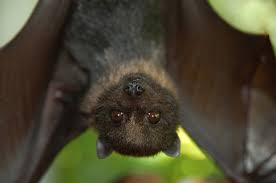
We have bats in our belfry! Lucky us.

As crazy as that may seem, we ARE NOT crazy (Oh, you want proof?) but we do have bats.


Backstory: Upon retirement a while back, we moved to our forever home (we hope) on a lakefront in North Carolina. When friends would visit, they marveled that we seemed to have no mosquitos, which we don't, thanks to a multitude of bats.

Bats are curious creatures to say the least. As fable has it, Count Dracula could morph into a bat and bite unsuspecting persons causing them to become zombies. Having seen lots of bats close-up and never, to my recollection, seeing a zombie in human or mosquito form, I figure those bats must be eating the mosquitos.

Bats are the only flying mammals, capable of true and sustained flight. They are nocturnal and incredibly adept at devouring mosquitos. In Austin, Texas, a popular tourist attraction is the home of 1.5 million Mexican free-tail bats under the Congress Avenue Bridge. At about dusk, as crowds watch, the bats venture out en-mass on their nightly quest for mosquitos, often ranging as far as 25 miles before returning home by dawn. It is an enormously interesting and beautiful sight.

Bats leaving from under the bridge on their evening search for food
Back to my story: So this morning, about 5:15, as my wife and I sat on our second story deck with a wakeup cup of coffee, we had our own bat show.  In the pre-dawn light we were treated to the dark shadows of hundreds of acroBATic creatures flying circus-like routes of loops, dives and swoops toward us as if for our entertainment, sometimes encroaching three to four feet into our space, for 45 minutes or so.

Bats leaving from beneath the bridge
While bats are not blind, they have a refined 'radar-like" sense that lets them fly with tremendous agility at great speed, avoiding obstacles, each other and us as they hone in mid-flight on mosquito after mosquito.

Then, at the sound of a bird's call, they just disappeared, figuring perhaps it might be a good time to go hang upside down for the day.

Isn't nature spectacular in every way?
 

Tuesday, July 21, 2020

How bad was Jefferson? Maybe not a bad as we think, but it is a nuanced path for sure.

Thomas Jefferson

"History is written by the victors," said Winston Churchill, on how the story is told.

Our history has one of our 'founding fathers' and writer of The Declaration of Independence  as a slave owner.

So do the statues stay or go?

My last blog post on Hamilton, the musical,
 asked how a man who wrote "... all men are created equal, that they are endowed by their creator with certain unalienable Rights,  that among these are Life, Liberty and the Pursuit of Happiness... " could also be a slave holder?

Was Jefferson 'two-faced' or is there a little more to be understood? Continuing, Jefferson wrote the clause that seemed to mandate the eventual abolition of slaves:  "... That whenever any Form of Government becomes destructive of these ends, it is the Right of the People to alter or abolish it, and to institute new Government, laying its foundation on such principles."

Here is a most interesting elaboration on how Jefferson might have 'pulled it off, ' byDon Tortorice, a former attorney and professor of the Law School of the College of William and Mary as it appeared in The Pilot, a newspaper in Pinehurst, NC. just last week. It seems to put the opposing elements of Jefferson's story in a modifying light.


Should Slave Owner Jefferson Be a Hero?

"We hold these truths to be self-evident, that all men are created equal." Those are the transcendent words that begin the second paragraph of the Declaration of Independence, written by Thomas Jefferson. But was he a true American Hero? Does he deserve the major monument building created in his honor and superbly visible to all as they cross the Potomac into Washington, D.C.?

Let us consider some facts that can be assembled about the man. He owned more that 600 people over the course of his life and profited directly from the institution of slavery. It is also contended, with convincing evidence, that he fathered a number of children with one of those slaves. 

Just stopping here, we might conclude that he was no hero, but just another enslaving despot who should have the historical cloak of heroism snatched from his back. But if we look closer--if we look broadly with an eye that is not only critical but discerning and circumspect--a singular conclusion becomes more difficult.

At the time of the American Revolution, Jefferson was actively involved in legislation that he hoped would result in slavery’s abolition. In a draft of the Virginia Constitution (actually the second draft he submitted on June 13, 1776) he would have prohibited the importation of enslaved Africans.

Then again, on June 18, 1779, he proposed an ordinance that would ban slavery in the Northwest territories. Admittedly, in a sea of complacency, he always maintained that the decision to emancipate slaves would have to be part of a democratic process.


Abolition would be stymied until slave owners consented to free their human property together, in a large-scale, orchestrated act of emancipation. To Jefferson, it was contrary to the principles of the American Revolution for the federal government to enact abolition by forcing planters to free their slaves. He knew that realistically, it would never happen.


But in a preserved letter to Thomas Cooper on Sept. 10, 1814, he continued to describe slavery as a "moral depravity" and a "hideous blot," and in another to William Short on Sept. 8, 1823, he voiced  the opinion that slavery presented the greatest threat to the survival of the American nation.


Jefferson consistently espoused the opinion that slavery was contrary to the laws of nature, views that were radically liberal in a world of Southern states where slave labor was the norm and reality was that slavery was becoming more economically entrenched. The slave population in Virginia skyrocketed from 292,627 in 1790 to 469,757 in 1830.


Jefferson had hoped that the slave trade would weaken, and slavery would come to an end. Instead, slavery became more widespread--and profitable. In an attempt to erode Virginians' support for slavery, he discouraged the cultivation of crops heavily dependent on slave labor, specifically tobacco and encouraged the introduction of crops that needed less field labor, such as wheat, sugar, maples, short-grained rice, olive trees and wine grapes. But by the 1800s, Virginia's most valuable economic asset was neither crops nor land but slave labor.


Jefferson's belief in the necessity of ending slavery never changed. From the mid-1770s until his death, he advocated the same plan of emancipation. First, the trans-Atlantic slave trade would be abolished. Second, slaveowners would "improve' slavery's most violent features, by bettering--Jefferson used the term 'ameliorating'--living conditions and moderating physical punishment. Third, all born into slavery after a certain date would be declared free, followed by total abolition. 


Like others of his day, he supported the removal of newly freed slaves to the lands of their origin. However, the unintended effect of his plan was that the goal of 'improving' slavery, as a step toward ending it, was used as an argument for its perpetuation. Pro-slavery advocates after Jefferson's death argued that if slavery could be 'improved," abolition was unnecessary.


Jefferson had written that maintaining slavery was like holding "a wolf by the ear. We can neither hold him, nor safely let him go." He was concerned that his cherished federal union, the world's first democratic experiment, would be destroyed by slavery.


To emancipate all slaves, immediately, on American soil, Jefferson feared, could result in a large--scale race conflict that could be as brutal and deadly as the slave revolt in Haiti in 1791. But he also believed that to keep slaves in bondage, with part of America in favor of abolition and part of America in favor of perpetuating slavery, could only result in a civil war. It did, and the result was more young America deaths that any other war we have ever fought.


Our forefathers should have listened to him--early on--from the beginning. He was right. I submit that his monuments should stand."


Disgracefully, total slave population in America was estimated at 6 million-plus. So it was slave owner Jefferson who foresaw and laid the legal groundwork for their ultimate freedom from slavery. How twisted is that? 

Friday, July 17, 2020

My name is Hamilton... Alexander Hamilton.


It's been 5 1/2 years since Hamilton debuted on Broadway and the world is still agog over it's magnificence. 

It was a happy chance for those of us who haven't seen--or couldn't afford to see--the stage play, now to view it in film format on Disney +  (Disney Plus). It was released just weeks ago, before it's planned release a few year later, as a covid-19 'treat' to take our minds off these really difficult times. Thank you!

The filming was during Hamilton's original run with Lin-Manuel Miranda who conceived and wrote
Lin-Manueal Miranda
the whole thing, and the entire first cast, so what you see is what those paying thousands of dollars a ticket saw... except better. With multiple cameras and sound mics, we saw close-ups and critical dramatic angles that those in the theater couldn't see or hear as well.

But really, the theater has all the personal drama and crowd effect, so maybe it's a draw. Yeah, there is a lot to say about 'in-person' and being a part of theater history. But that doesn't diminish the awe of seeing and appreciating it in any format.

Here is what happened as this play came into being:

The score for the show is all hip-hop, the genre that, like it's second cousin, rap  had found musical footing across the world... except for those "not getting it." (read older or heard of hearing.) Hamilton seemed to change all of that as the lyrics were fresh and historically relevant, just the way we were taught in school, but better.

The way it is performed is upbeat and familiar. The music 'caught on' and was embraced by the young in age and spirit. In fact, those in middle school and older fell in love with it. All of my grandchildren knew every word of every song and they sang them over and over, performed them for friends and family and learned history as it had never been taught before.

The Hamilton cast album quickly sold more than 450,000 copies since its release, more than any other since Jersey Boys years earlier. Those who couldn't or didn't want to listen to hip-hop before Hamilton came to realize what a wonderful genre it was for this show. It raise our spirits. We 'got it!'

Music has always had that power. Before there was the written word, it was music in one form or another that carried tales, legends and history forward. Music has retention in ways words spoken and written do not.

The trick of Hamilton and hip-hop is how rhyming is made to work for any story told. It is not by rhyming 'moon' and 'spoon' or 'love' and 'dove.' That would be far too limiting.

The Wall Street Journal  gave a really interesting and simple rhyming synopsis on Hamilton:

There are perfect end rhymes:   A staple of song and poetry is perfect rhyme. In a perfect rhyme, the vowel sounds and consonant endings of two words are identical, as with the words “squalor” and “scholar” in the opening song.

There are internal rhymes:  The “squalor” and “scholar” rhymes land at the end of lines. But this pair also rhymes with syllables in the middle of lines, such as “impoverished.”

There are imperfect rhymes:  Most of the rhymes in this verse are imperfect—the matching sounds are not identical. For example, “Scotsman” and “dropped in” aren't perfect rhymes, but they partially rhyme because they share similar vowel sounds and consonant endings.

And when hip-hop works best--as in Hamilton--different rhyme schemes, well written phrases with the right emphasis and pacing within the framework of an ingenious scrip make for what works. And my, how it works.

A couple of historical notes:

Remember when Lin-Manuel Miranda tried out his first song for Hamilton in 2009 at the White House for President Obama and family? He tepidly told The President that he was going 'off-script' with a new idea for a play about Hamilton. He received a few polite laughs as if he was kidding, then debuted what was to become the opening number of the play, to the great satisfaction of those present. Six years later, no one was politely laughing because they were too busy applauding.

Hamilton, the play, is a credible historic depiction of actual happenings, however, the real people did not hip-hop and dance like in the play. But the story performed is historically close.

That being said, Thomas Jefferson, who was the primary writer of  The Declaration of Independence, was a slave holder. This was odd in that The Declaration he wrote states "... all men are created equal, that they are endowed by their creator with certain unalienable Rights,  that among these are Life, Liberty and the Pursuit of Happiness... " I guess Jefferson meant eventually.

Jefferson was a masterful writer but his character, according to Smithsonian Magazine, lagged somewhat behind. He did write further, continuing in The Declaration of Independence, "... That whenever any Form of Government becomes destructive of these ends, it is the Right of the People to alter or abolish it, and to institute new Government, laying its foundation on such principles."

Technically we did that, though we are still far from done in more meaningful ways and must continue the journey to completion. As our Constitution mandates we do! 

Perhaps the best reflective counter-balancing to slave ownership is that Hamilton is the creation of Lin-Manuel Miranda of Puerto Rican descent and mixed parentage, along with the participation of some of his close collaborators. The original cast, though not by intent, is predominately people of diversity in the various roles including Hamilton, Washington and Jefferson himself, reflective of America then and as it always has been, whether acknowledged or not.

Washington was also a slave owner but at his death, he ordered all to be free.

How can I see Hamilton? It is only streaming on Disney + (Disney Plus) and available for about $7.50 (tax included) which is the fee for one month on that premium channel. Your subscription will continue unless you cancel, which you can do without penalty. You will not be able to see it if your first month is a free trial. You have to commit to at least that first month. And who knows, maybe you and your kids will love what is offered. One tip: turn on the captions when watching. It will help catch every word.

It you 'are into it' as so many are, you may want to get the ultimate book on the words and making of the stage show, scene by scene, and so many other photos and insights on the trials and tribulations of the birth of this spectacle, from original thoughts to the final product. It is "Hamilton: The Revolution" written by Lin-Manuel Miranda and Jeremy McCarter. I forget the cost but it is worth it if you love this play and want to know more as so many have.

PS: King George III kind of steals the show.


Thursday, July 9, 2020

Is this who we are? It really seems like it.


Only movies can visualize a most complete story from every perspective over any time span. That's why some are really great. And while many are fiction or fictionalized, the story is only bound by the worthiness of the product and the talent and imagination that goes into its production.

Sometimes the message is not good and/or not well done. Those efforts are often called 'turkeys.' And sometimes the message feels 'spot-on.' Those are called "award-worthy."

This one, "The War of the Roses," from 1989 proved itself 'award-worthy' in every category and it sadly felt like this is us. Even its title and basic sense of foolishness came from the real Wars of the Roses civil war battles between 1455 and 1487 for control of the throne of England.

The movie and its stars were nominated for a British Academy Film award, the Berlin International Film Festival Golden Bear and three Golden Globe Awards. After 40 years, it's Rotten Tomato score is 85,  and it was a box office success.

So if you haven't seen the movie, or forgot, here's a rather long and well done synopsis from Wikipedia with thanks:

"Lawyer Gavin d'Amato is in his office discussing a divorce case with a taciturn client. Noticing the man's determination to divorce his wife, Gavin decides to tell him the story of one of his clients, a personal friend of his.
Eighteen years earlier, Oliver Rose, a student at Harvard Law School, meets Barbara at an auction on Nantucket, where they bid on the same antique. Oliver chats Barbara up and they become friends. When Barbara misses her ferry home, the two end up spending the night together. Eventually, the two marry and have two children and settle in Washington D.C.Over the years, the Roses grow richer, and Barbara finds an old mansion whose owner has recently died, and purchases it. However, cracks seem to be forming in the family, such as the children being overweight due to Barbara spoiling them with treats. As Oliver becomes a successful partner in his law firm, Barbara, who was a doting and loving wife early in the marriage, appears to grow restless in her life with Oliver, and begins to dislike him immensely.
Oliver, for his part, cannot understand what he has done to earn Barbara's contempt, oblivious to his controlling, self-centered, indifferent and generally dismissive behavior toward her. When Oliver believes he is suffering a heart attack the day after an argument, Barbara does not show any remorse or concern for his well-being, and ultimately admits that she no longer loves him and wants a divorce. Oliver accepts, but tension arises between the two during a meeting with Barbara's lawyer when Barbara makes it clear that she wants the house and everything in it, even using Oliver's final love note to her (which he had written in the hospital) as leverage against him in their legal battle. Oliver hires Gavin on a retainer as his legal counsel. Barbara initially throws Oliver out of the house, but he moves back in after discovering a legal loophole that allows him to stay while the outcome of the divorce is pending. As a result, Barbara immediately begins plotting to remove Oliver herself, even going as far as trying to seduce Gavin into siding with her instead.
In an effort to compromise, Oliver offers his wife a considerable sum of cash in exchange for the house, but Barbara still refuses to settle. Realizing that his client is in a no-win situation, Gavin advises Oliver to end the conflict by leaving Barbara with the house and starting a new life for himself. Oliver responds by firing Gavin and decides to take matters into his own hands.
At this point, Oliver and Barbara begin spiting and humiliating each other in every way possible, even in front of friends and potential business clients. Both begin destroying the house furnishings; the stove, furniture, Staffordshire ornaments, and dishware. In addition, Oliver accidentally runs over Barbara's cat in the driveway. When Barbara finds out, she retaliates by trapping Oliver inside his private sauna, where he nearly succumbs to heatstroke and dehydration.
While the children are away at college, Oliver eventually calms down and attempts to make peace with Barbara over an elegant dinner, but finally reaches his breaking point when Barbara serves him a paté which she implies was made from his dog (which turns out to be a bluff). Oliver physically attacks Barbara, who flees into the attic. Oliver boards up the house to prevent Barbara from escaping, while Barbara loosens the chandelier to drop on Oliver. When their German housekeeper Susan pays them an unexpected visit during the night, she senses something is terribly wrong and discreetly contacts Gavin for help. By the time Gavin arrives, Oliver and Barbara's quarrel has culminated in the two hanging dangerously from the insecure chandelier. During this time, Oliver admits to Barbara that despite their hardships, he always loved her, but Barbara does not respond. Before Gavin can come inside with a ladder, the chandelier's support cable fails, leaving only the electrical wiring to the fuse box supporting the couple and the chandelier. Despite Oliver's conviction that each wire can hold 'at least two hundred pounds', the wire eventually fails as well, sending Oliver, Barbara, and the chandelier crashing violently to the floor. In his final breaths, Oliver reaches out to touch Barbara's shoulder, but Barbara uses her last ounce of strength to push his hand away, firmly asserting her hatred for him even in death.
Finishing his story, Gavin presents his client with two options: either proceed with the divorce and face a horrific bloodbath in court, or go home to his wife to settle their differences properly. The client chooses the latter, and Gavin, satisfied, packs up his office to go home to his own family."

Is there a moral and/or a take-away? Of course. This movie features a basic lack of morality, kindness, warmth, respect, love, common sense and, as they say in commercials, "more, much more."
"The War of the Roses" is called a black comedy because it is dark and it's characters look ridiculous to any observer as how small and inhuman, evil, lying, cheating and non-compassionate, revenge-seeking and hateful to the extreme that they are.
And if you think that this is pointed politically at one of us or another, you are taking it wrong. That is on us all from time to time, and we are ridiculous.
It was Abraham Lincoln who perhaps said it best in his "house divided" speech when he accepted the Illinois Republican nomination for Senate in 1858 and those words ring just as true today, or more so, as ever.
Want to see the movie? It is a great watch and available on Amazon Prime.


Saturday, July 4, 2020

My career in spying: a personal confession and tale of then vs. now

That's me, the brains of the outfit
with the head spier, my sister


It may be hard to believe but these two seemingly innocent youngsters are spies. I should know. That's me and my sister and I think it's about time we came clean. Sure, we look innocent enough but in our youth we ran a spy ring.

This photo, as I recall, was when "the mob" was trying to fit us with cement overshoes and take us 'to sleep with the fishes,' but my sister had to go to the bathroom and couldn't stand still, so the concrete didn't set. The plot was foiled and we lived to spy another day.

Yes, there's a backstory and since the statute of limitations has expired, I can spill the beans.

Telephone (not smart)
It was a time before television, the internet, social media and Pong. Even telephones had a handle which was connected to the phone which was connected to the wall by a short cord. It looked and worked so different that you would't know how to use it if you had to. And it would kill you to know that if you weren't home to answer the phone, there were no message machines and you would never know who called you.

We did have a radio, that was all. We listened to the radio on Saturday mornings and heard "Commander Cody of Space Patrol" and "Let's Pretend" with Smiling Ed McConnell and Froggie, the gremlin. "The Lone Ranger" with his faithful sidekick, Tonto, was on during the week sometime. Comic books we our social media. Yeah, 'the olden days.'

It was a peaceful time when kids played outside from morning to night. There was nothing to keep us in except having to clean the table after we ate or pick up our toys. Yep, our world didn't have a screen or buttons or smart phones. All we had was the sun and moon and about four square block of neighborhood that was our domaine.

In the summer time when school was out and on weekends year round, we lived outside from after breakfast to time for supper. We knew when supper was because mom would open the front door of our house and yell "JERRY! MARILYN! SUPPER!" as loud as she could. And in our neighborhood, every kid who heard the call repeated it so that we were sure to get the message even if we were out of ear-shout. And after supper as it was getting dark, we begged to go outside again and play 'Hide and Seek."

Now about the spy business:

Getting a very large cardboard box was how we got into "the spy business." Mom and dad had to buy a new sink and in those days, it came as a single unit with cabinets and a top that stretched about 8 feet long x 4 feet high and 3 feed wide. After the sink unit was unpackaged, we grabbed the box to build a clubhouse in our tiny backyard. We cut a door and a few windows, found a small table that fit and "viola!", it was a clubhouse. It was the center of our world for a time and it became whatever we chose it to be.

We got 'our gang of the moment' together, me and my sister, Sally and Carol, Dick and Patsy. Then we did what kids will do,,, deciding how we would use our new clubhouse. After we ate all the candy we could and just sat around, we organized clubs, elected officers and did whatever the current club was formed to do.

We had The ABC Club to find everything we could to spell out the alphabet: A is for apple, B is for butterfly, etc.

Then we formed the Good Health Club which included taking our temperature with a stolen thermometer from one of our medicine cabinets and playing doctor (the good kind, not anything bad) and seeing who could run the fastest, jump the highest, etc.

And then we formed the notorious Spy Ring Club where we would spy on anyone who needed spying. Here are our official notes:


As you may have read, The Rules are very specific and demanding, in Roman numerals no less:

I.   You must have a hobby
II.  You have to obey the President and Vice President
III. You must not be a tattle tale.

The officers (we always elected officers by vote and when all the votes came out tied because everyone voted for themselves, we went by age.) That's why Sally was always President, I was always Vice President, Carol was always Treasurer (Important because dues were a nickel or dime if we had it), Marilyn was Secretary (to take notes, of course) and Patsy was head spyer (sic).

We always hid our written notes and findings in a coffee can which we buried so years later whoever found them would have a valued record of our findings.

Our mission was written elsewhere and is no doubt still buried someplace where no one recalls. But someday, like the Dead Sea Scrolls, it will be found and revealed to the masses. I however, being Vice President, determined with The President, how we would operate:


  • The head spyer (sic) would hide out where she could see whoever enters or leaves Frasco Brothers Groceries (my grandpa and uncle's store) on the corner and make note of comings and goings. (We knew almost everyone and where they lived).
  • It was very important not to be seen so our surveillance was always behind trees or bushes. And if spotted, we had to run away. 
  • We would then send another spyer (sic) to determine if he/she had groceries to carry and needed help to get home, which we would supply.
  • And if it was a stranger to us, all would follow to determine if they actually lived in our neighborhood or perhaps were just there to rob or kill someone.
  • To check for anything that seemed out of place and report it to the President or Vice President, enter it in our log and then go out to run and play as primary school kids do.
  • And most important, we charged ourselves to "Please do not get this paper dirty."

After we all got bored, which didn't take long, that club would be forgotten until the next time we needed something important to do and a new club would be formed.

So you got us! Don't bother calling the cops because they can't touch us now. Ha ha.

Author's note: It really was a simpler time to be a kid.


Tuesday, June 30, 2020

Do you know Antoine De Saint-Exupery? The picture is your first hint.


Antoine de Saint-Exupery is a considerable person in many respects but he is most recognized as the author of The Little Prince, one of the best selling and most translated books ever published. This novella has been translated into 361 languages and dialects and has sold more than 140 million copies worldwide.

The book itself has it's own backstory--more of that later.

de Saint-Extupery
But the author, de Saint-Exupery, as he was known, was a French writer, poet, aristocrat, journalist, artist and pioneering aviator.  His full name is Antoine Marie Jean-Baptiste Roger comte de Saint-Exupery.  (Those French, they have a different name for everything.) He has the look of a French aristocrat don't you think?

He was good at quite a few things. He wrote nine books and received several of France's literary awards as well as a United States National Book Award. And he was a noted pilot taking his first flight in 1912 when he was 12, back when flying was still in its barnstorming era, not long after the Wright Brothers showed it could be done.

De Saint-Exupery learned to fly in the French military and was forever smitten. He worked in several professions but always came back to flying... and writing and drawing all the while. In 1926 he flew the mail for Aeropostale from Toulouse, France to Dakar, Senegal, not unlike Charles Lindberg. And daring like Lindberg, he tried to set a record flying from Paris to Saigon. The difference is, he and his co-pilot crashed in the Libyan desert where they almost died of thirst before meeting a nomad on a camel. It was during this adventure he conceived the idea for The Little Prince. You may recall, as his book begins, the The Little Prince mysteriously appears to him in the desert on the day after this crash.

He almost lost his life crashing again in 1938 flying from New York City to Tierra del Fuego, Argentina. Planes then hadn't yet achieved the records for safety of today's air travel. And to disprove an old adage, the third time was not a charm. In 1943, de Saint-Exupery, still suffering emotionally from this second crash, had rejoined his French air squadron and insisted he be given a long reconnaissance flight... a flight from which he never returned. He was 43.

Back to The Little Prince, de Saint-Exupery worked with the idea over time and would often write The Little Prince and his other books until he was content. The Little Prince was actually written in New York where de Saint-Exupery lived for a time up to World War II and was first copyrighted in 1943, the year he died.

He often wrote on a knee-pad strapped to his leg as he flew long distances. His colleagues had visions of him crashing but he proved himself adept in both flying and writing... often at the same time.

Being somewhat severe critic of his own work, he wrote and rewrote until he felt satisfied. He also did all of the book's drawings and artwork, such were his talents.

The Little Prince was/is a most popular children's book, one I had never read until just recently. That's kind of "the thing" with well-written books, they may appeal to all ages on the strength of their stories.

This charming tale is written with the perspective of a child's eyes and mind into the world of what children become... adults. It is fanciful and descriptive of that perspective as to what sadly, some of us have become and how strange it looks to the observing innocent child. It is a rich moral tale in how differently we often let the grown-up world change our lives in a less joyful way. As we see ourselves through the Little Prince's eyes, we are somewhat disappointing. It is a simple wake-up to what is really important and what is lost in the the translation of aging.

de Saint-Exupery's 'Rose'
De Saint-Exupery puts all of himself into this book: his life, his home and his love. Where is his love in the book? It is in the one object that drives the Little Prince, his rose that he left on his small planet. The rose that he tends and cares for, the rose he covers at night so it will be safe from the cold and creatures that might devour it. The rose that is the most precious thing he has and cares for. And not coincidentally, this vain and petulant rose of The Little Prince is the inspiration and center of de Saint-Exupery's life, his Salvadoran wife, Consuelo de Saint-Exupery.

The fantasy of the book is well-told and enjoyed because no matter the reader, there is a lesson to be had in a strange and different way.

Friday, June 19, 2020

Suicide IS NOT painless... as the TV show MASH theme song said. In fact, hanging as suicide seems not always suicide at all, except sometimes, as a cover-up to lynching.

I have a true story to share. It does have a reason for being told.


This is my dad's family. Aunt Ethel is at the far right. I never knew her. She killed by a zealous suitor (boy friend) when she was 25. That youngest sitting boy is my dad. Grandma and grandpa were early 1900 immigrants from Italy. They had five girls, three boys and lived in Chicago.

As kids, we were told Aunt Ethel lived in Italy, but as I grew older, it was little and reluctantly discussed. I needed a better answer. Years later and with the help of the internet which didn't exist until dad and all of his family had died, I searched the Chicago Tribune's records for information thinking her killer would surely have been executed as happened often in those days of Al Capone, Nothing.

The searchable archives didn't go back far enough so on a whim, I emailed the Tribune's obituary editor one evening. Thirty minutes later, I received a copy of a six inch story headlined: "Couple die in a double suicide pact." 

It was the story of my Aunt Ethel and her boyfriend who, one afternoon at a motel, shot her then himself. The police were quick to say it was a double suicide because it seemed possible and that closed the books on anything left to be done. The story also noted that my Aunt Ethel had two bullet wounds. The bullet that killed her passed through her arm, as if held up in defense, before entering her head. She left no note or displayed any such thoughts I learned. It didn't seem to me that this was a mutual act and in fact, it probably was a murder and suicide.

Aunt Ethel was said to be a delight, bringing joy to those who knew her. She was always smiling. Dad's family felt certain that Aunt Ethel knew nothing about such a plan. The boyfriend was not at all liked by Aunt Ethel's family and the two of them may have been separating... or not.

So here's where this story has a 'today' relevance:

Have you noted in this last month that there have been six (6) separate deaths by hanging--four black men, one black woman and a hispanic man--in public areas? All are being initially called suicides. Really? Further evidence and autopsies are still pending. What will they show?

From 1862 and 1968 there were 4,978 lynchings in America, 3,436 blacks and 1,247 whites, mostly made up of those trying to help blacks or for various other similar reasons of the day. The last noted lynching was as late as 1981in Mobile, Alabama. That's within many of our lifetimes!

But really? Six black suicides by hanging in public places to be seen by all in these last few months? That would be an extremely rare and bizarre coincidence, especially by black men at this specific time... if they actually were suicides... or more believable, murders.  When a spokesman for the police, in one of the two hangings of black men this past week, talked about finding "the victim," it didn't seem he was talking about a suicide. A victim takes two people minimum.

So you think we don't have a deep historical background in racism that continues to this day? As late as now we still have no federal law against lynching! State laws yes, but nothing federal.

"Since at least 1900 the House and Senate have repeatedly failed to pass such a bill," said the New York Times. "The bills were consistently blocked, shelved or ignored, and the passage of time has rendered anti-lynching legislation increasingly symbolic. There is now a house bill called the Emmet Till Anti-lynching Act."  It, at long last, has has bi-partisan support, something that hasn't happen until now.

Isn't it odd that the two 'most outcast' (my term) races in the United States are the American Indians from whom we stole this country and the blacks who were brought here against their will to do the bidding of white masters as slaves?

This is all relevant stuff as we come to a newer dawning of Black Lives Matter. Let's pray that sticks or we are doomed as a people of God, or not, and as a country.

BLACK LIVES MATTER!   


Monday, June 15, 2020

L-O-V-E / H-A-T-E : There's a lot of that going around. But I have found a resolve!


The man is actor Robert Mitchum in the 1955 thriller, The Night of the Hunter. Mitchum plays a religious fanatic and serial killer who intends to charm an unsuspecting widow and steal $10,000 hidden by her executed husband. On his right hand he has tattooed his fingers with L-O-V-E, On the left hand, H-A-T-E and that sets the stage for this chilling adaption of a true story.

In 1992 The Night of the Hunter was deemed "culturally, historically or aesthetically significant" by the United States Library of Congress and was selected for preservation in the National Film Registry.  In 2008. An influential film magazine called it the second best film of all time. First best: Citizen Kane, of course.

But today, L-O-V-E / H-A-T-E is the diametric opposite that seems to prevail most dominantly. The Declaration of Independence (It's a short read) says all men are created equal and a lot more. It seems to wrap around many of the key issues we face as a country and our 'inalienable rights' that the Constitution of the United States of America further defines.

L-O-V-E / H-A-T-E  extremes:

  • Are all men created equal or are they not?
  • Do black lives matter or do they not?
  • Do law enforcement officers sometimes over-react in a biased way or is enforcing to death mostly ok?
  • Are demonstrations of anger a human right or are they too dramatically out of control and should be suppressed to acceptance?
  • Is it all for one and one for all or I'm doing ok thank you?
  • Is it a right to have access to health care or only if you can afford it?
  • Is is acceptable some have to live in poverty or I've earned mine and so should everyone else?
  • Are there equal opportunities for all or why should there be?
Other key issues that are in conflict include homelessness, education, no limit gun rights (should blacks own AR-15s as is their right?... should anyone own AR-15s as is their right?), and, as said in many ads, more, much more. 

Maybe if L-O-V-E / H-A-T-E had a third possibility, there could be more empathy to other differences. 

Aha! I think I have it! What if the third possibility was U-N-D-E-R-S-T-A-N-D-E-R-S-T-A-N-D-I-N-G? If only we had 14 knuckles to tattoo. Oh, wait a minute. We do! 

Akshat Saxena in India has polydactylism--having multiple digits. As CBS reported in 2011, Saxena not only has 10 toes on each foot, he has 7 fingers on each hand! Perfect for U-N-D-E-R-S-T-A-N-D-I-N-G-! See?

Problem solved!


Saturday, June 13, 2020

We lost this great man just a few weeks shy of his 101st birthday. Bet you don't know of him and why he was so renown.


This is the legendary Dr. Thomas Freeman who imprinted so many young and older minds with perhaps the most valuable tool of their lives... how to make a point.

Dr. Freeman joined the staff at Texas Southern University in 1949 and was still at work at age 100 teaching debate. He was hired as a philosophy professor but two years later found his truest talent and greatest joy as debate coach.

In just three months, his largely unrecognized team surprised Harvard and the University of Chicago debaters to win its first national championship, skyrocketing TSU to the forefront of the college debate world. His successes continued throughout his 70 year career as did his reputation and the admiration of his teams and those who knew him.

His most famous pupil was a young Martin Luther King Jr. He also taught Representatives Barbara Jordan and Mickey Leland as well as Grammy winning singer Yolanda Adams. But perhaps no notables were more valued in his heart than the thousands of students he taught.

ABC newsman David Muir did a feature on Freeman's legacy and its most touching moment was to watch him greet and receive admiration from many of his graduated students as they returned at homecomings and special events for him.

So one 'kinda gets' the picture of a teacher that makes a life-changing difference in his student's lives, as David Muir showed in the short tribute of his life, a beloved man that changed many worlds for the better.


Personal aside:
I had one of those, and maybe you did too. Mine was Dr. Paul Snider (left), my journalism professor and mentor over those college years. He taught news reporting, editing, etc. as one would expect, but he impressed in us the moral responsibilities of a journalist and how very important is is to get all the verification of the stories you tell because, to paraphrase, "in our field, nothing is more important than the integrity and respect earned by doing it accurately and fairly." 

In his classes, every fact error--Madison Theater instead of Madison Theartre as it was named--received a large red stamp (FACT ERROR) and an automatic F. That was my first... and last FE.

He told a story of how, in his opinion, he lost a Pulitzer Prize when he was a photojournalist for a network news company. He was covering a local story of an auto accident that took the life of a toddler on a tricycle, While other photographers were shooting the scene of a crumpled tricycle and a blanked covering of a small body, he chose to look elsewhere. In a walk around the child's house, he saw through an open back window, the grief-stricken father sitting at the kitchen table with his head buried in his arms not able to reconcile what just happened. "There was my Pulitzer, I thought. But as I raised my camera to get the picture, I realized that this was a photo that was not mine, or anyone's to take. I lowered my camera and walked away." 

In that teaching moment he told us that there are some things that are so personal and profound that the world should not steal. What a deep and lasting lesson. Sadly today, that precept does not seem to exist. 

And we would automatically fail his course if we would ever say "One picture is worth a thousand words." It isn't.


In 2007 Denzel Washington asked Dr. Freeman to coach his young actors for his film "The Great Debaters" a real life story of a 1930 team of unheralded black debaters who upend a highly favored white team to win the championship, a most revolutionary event of those days.

Dr. Freeman modestly saw himself as an "... instrument in the hands of God, working with people on their development. If they are successes, then I am successful.

His motto known by all who knew him and repeated in unison by four of his students for ABC news: "We do well. What we don't do well, we don't do at all."

In today's world there are many points to be made, but many speakers and notably political figures and high office holders believe telling only half the story or over dramatically accusing your opposite of lying or just plain masking the truth are alternative ways . Fake news is an oxymoron that really doesn't exist... however it has gained popular usage to make the dictionary. My, how far we have come... or better said, how low have we fallen.

Saturday, June 6, 2020

A confession: I enjoyed this clever 'Lady on a bicycle' impromptu-sculpture in front of an antique shop that I decided it was 'blog-worthy.' So now I have to make up something to say.


This is "Lady on a Bicycle" named by me. She is made of ceramic pots as you may notice.

Usually when I blog--and I have nearly 700 pithy, serious and humorous world-changing posts btw, worth reading, rereading and memorizing for wonderful cocktail party conversation--I have an idea of what to say and I use supporting art/photos to illustrate. For this one, I have to make-up something that goes with the picture. Hopefully you will find it memorable and Pulitzer Prize-worthy. Here goes:

    Harry Potter

Obviously this pot sculpture was inspired by the Harry Potter books that have lured readers young and will forever live in our hearts. The sculpture is a testimonial thank you to J.K.Rawling.

Peter Rabbit


Wait a minute! Obviously this sculpture was inspired by Beatrix Potter who gave us such childhood pleasures as "The Tale of Mrs. Tiggy-Winkle" "The Roly Poly Pudding" and most famously, "The Tale of Peter Rabbit." Of course.
Mrs. Potts and Chip


Or, there is Mrs. Potts in Disney's "Beauty and The Beast." Obviously this was the inspiration without
a doubt. And who could not love little Chip?


Mr. Potts, the rich banker
But of course, it obviously is the money-grabbing banker, Mr. Potter, in "It's a Wonderful Life." Certainly it was a reminder of how the very rich are prospering while those struggling are having difficulty affording food, rent and/or medical care.


So I asked the sculptor,* which 'pots' was your inspiration. And she answered, "It's not for any 'pot,' 'pots,' or 'potter' at all. You are missing the point. Those aren't just pots, they are FLOWER POTS for new growth, as her hair, and life as we know it to be... rich and fragrant and wonderful. Flower pots. Those flowers are where the inspiration lies. I was inspired by how good it made me feel when I saw Walt Disney's Bambi and it was the newborn Bambi that named the skunk Flower, the perfect name.

Disney's Bambi and Flower
I hope you have many flowers in your life, despite the occasional weeds which we can pull and throw away.

*Confession #2: Well, let's just say, IF the antique shop was open, I would have asked her but it was closed because of the CoronaVirus so I had to imagine what she might have said. OK, I won't get  a Pulitzer, for this but you must admit, I did find a good excuse to use that neat sculpture. The Pulitzer prize winning post is the next one.

And seriously, if you view my blog as a web page instead of just an email, you will see quite a large list of topics covered over the 700 or so blogs. Click on any that pique your interest. And thanks for reading.